
New space race is a five-layer economy, with satellites and “Space Race 2.0” representing only parts of it
The New Space Race can be defined as four spatial layers stacked outward from Earth, plus one cross-cutting layer that runs through all of them. Each layer is at a different stage of maturity, funded by a different mix of capital, and exposed to a different set of risks.
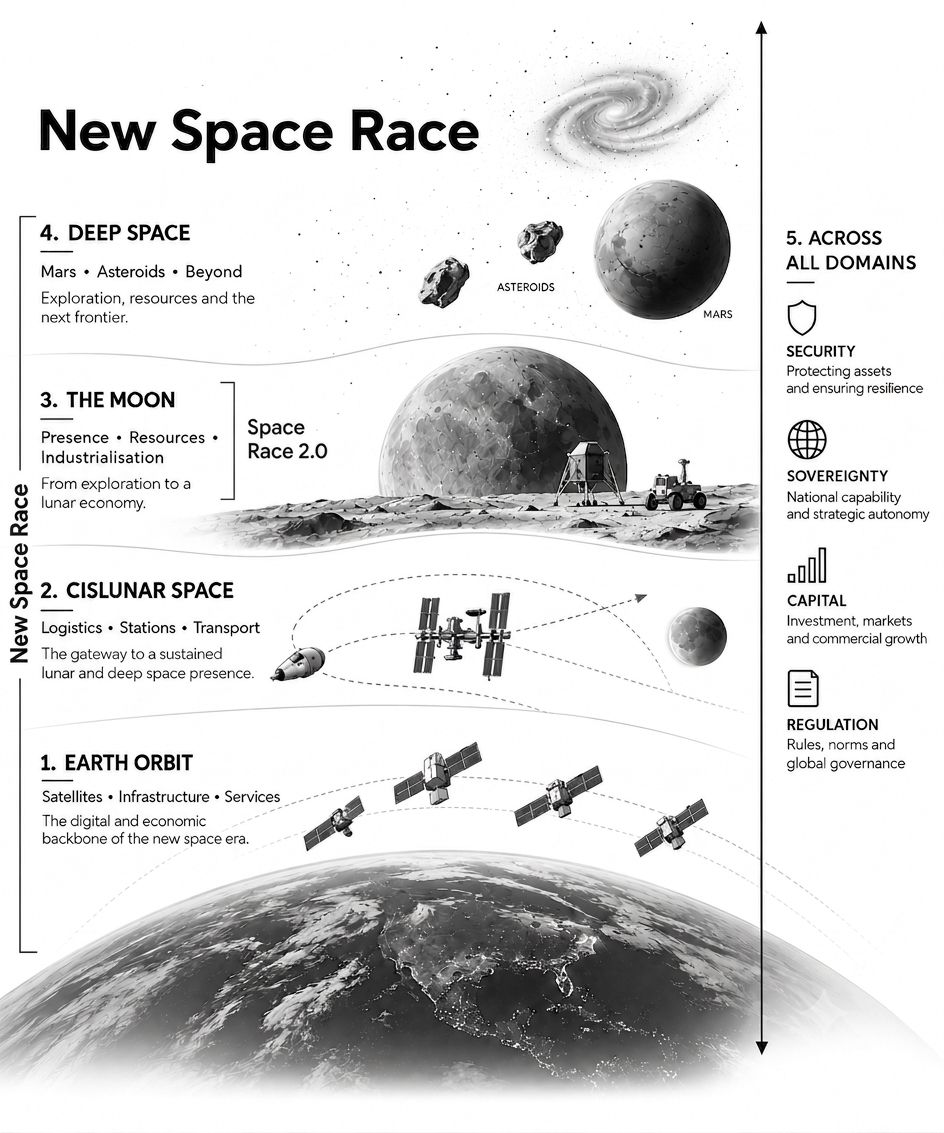
New Space Race - four spatial layers stacked outward from Earth, plus one cross-cutting layer that runs through all of them
Layer 1: Earth Orbit - mature, commoditising, consolidating
Earth orbit is the innermost layer and the most mature and commercially proven. Satellites and LEO connectivity are no longer “new space.” While launches and satellite constellations continue to attract attention, the more interesting opportunity is increasingly shifting to the infrastructure layer - what happens to satellites once they are in orbit.
Over the longer term, growth is expected to come from capabilities such as in-orbit servicing, space situational awareness (SSA), debris removal, mobility and logistics, and in-orbit computing / edge AI.
Layer 2: Cislunar Space - the emerging layer, and the most underpriced one
Cislunar space covers the logistics, stations and transportation infrastructure connecting Earth and the Moon. It is also where significant growth-stage capital is moving today.
NASA’s Commercial LEO Destinations program is funding successors to the ISS ahead of its planned 2030 retirement. Vast raised $500 million in March 2026, taking its total funding above $1 billion, to develop its Haven-1 and Haven-2 stations. Axiom closed a $350 million financing round in February 2026, backed by Qatar Investment Authority and others, to accelerate its modules and next-generation spacesuits. Blue Origin’s Orbital Reef, Northrop Grumman, and Voyager/Airbus’ Starlab round out the field.
NASA also reshaped its approach in March 2026 towards an “Ignition” model - a government-anchored hub with private modules - rather than fully independent commercial stations from day one.
Layer 3: The Moon “Space Race 2.0” - industrial policy, not a market
This is the one most people mean when they say "new space race," and it's real activity: NASA is raising its Commercial Lunar Payload Services (CLPS) contract ceiling from $2.6 billion to $4.2 billion, and has committed to three funding phases – Learn / Test / Build (2026–29), Early Habitation (2029–32), Permanent Operations (2032+) - at roughly $10 billion per phase. Intuitive Machines, Firefly Aerospace, Astrobotic, Blue Origin's MK1 lander, and lunar-rover contracts to Astrolab and Lunar Outpost (~$220 million each) are all live and flying in 2026.
But the honest framing matters here. There are projected 116 lunar missions over the next decade, and 64 of them (the majority) are government-led. Commercial players are almost all using CLPS-style contracts to fund technology demonstration, still hunting for a genuine non-government customer to close their business case. The Lunar Gateway station was cancelled in 2026, and Artemis timelines keep slipping. This is subsidised industrial policy building toward a market, not yet a market.
Layer 4: Deep Space (Mars, Asteroids, Beyond) - pre-commercial
This is where the gap between narrative and reality is widest. AstroForge became the first purely commercial company to win an FCC deep-space communications license, flew a flyby mission (Odin) in 2025, and is preparing its Vestri rendezvous mission for 2026 - on roughly $55 million in total funding. This is a real regulatory and technical milestone. It is not a business yet as no company has extracted, refined, or sold a gram of space-mined material, and total capital in the asteroid resource sector remains in the tens of millions, not billions.
NASA, meanwhile, is pulling back from its own Mars Sample Return program in favour of lower-cost competitive missions plus roughly $1 billion earmarked to prepare for eventual crewed Mars missions.
Layer 5: Across All Domains - the layer growing fastest, and most missed by CXOs
Security, sovereignty, capital, and regulation is not a "fifth vertical" sitting beside the other four. Global government space spending hit $132 billion in 2024, up 6.7% year-on-year, with sovereignty concerns (not commercial ambition) increasingly the stated driver - from GPS-alternative constellations to national lunar programs. Space domain awareness, in-orbit servicing, launch insurance, and space law are becoming board-level risk categories for companies that have never launched a satellite, simply because their supply chains, communications, and positioning / timing infrastructure now depend on orbital assets they do not control.
Space-based sovereignty and resilience are becoming procurement requirements, not preferences - for governments and for regulated industries (finance, energy, telecom, defense-adjacent manufacturing) that depend on space-based infrastructure. Getting ahead of this, through partnerships, resilience planning, or direct investment is now a genuine competitive differentiator.
In-situ resource utilisation: the layer within a layer
One area is particularly important to the future of the Moon and deep-space economy: in-situ resource utilisation (ISRU). ISRU is the technology and business case that ultimately determines whether Layers 3 and 4 ever become self-sustaining commercial layers, rather than permanently government-subsidised ones. It deserves its own closer look.
What ISRU actually covers:
ISRU spans three broad resource categories –
Extracting oxygen and water from lunar or Martian regolith and permanently shadowed craters
Processing metals and silicon from regolith for construction, radiation shielding and eventually in-orbit manufacturing feedstock
Use of locally available energy or harvesting local energy (solar, and longer-term, nuclear or regolith-derived) to power surface operations without shipping fuel from Earth
Of the three, oxygen extraction is furthest along and is expected to be the primary near-term commercial driver, largely because it feeds directly into propellant production - a market with an obvious, immediate buyer in the form of every lander and ascent vehicle operating in the cislunar environment.
How the economics are expected to unfold:
The ISRU market is estimated to reach approximately $1 billion by 2030 and, under an optimistic scenario, could scale towards $60 billion by 2040 as oxygen production, followed subsequently by metals and silicon, moves from demonstration to recurring supply contracts. That is a steep curve, and it should be read with the same caution applied to Layer 3 more broadly - the early years of that curve are overwhelmingly funded by government demonstration programmes rather than commercial offtake agreements.
The inflection point - the moment ISRU stops being subsidised R&D and starts being a self-funding supply chain - depends on propellant depots and lunar landers reaching a flight cadence high enough to make locally produced oxygen cheaper than oxygen shipped from Earth. This inflection point is expected to be in the early-to-mid 2030s.
Capital is already positioning ahead of the narrative:
Financing activity through 2026 suggests capital markets are starting to move ahead of the mainstream "orbit vs. Moon" narrative. Japan's ispace secured roughly $20 million (¥3 billion) in new bank financing on September 9, 2026, specifically earmarked for mission development - a signal that lenders, not just venture investors, are now underwriting lunar-economy timelines.
Layer 4 is showing a similar pattern, albeit at a much smaller scale. AstroForge has raised roughly $55 million against a mission that has no near-term revenue.
The signal is important - capital is beginning to position itself not only around what exists today, but around the infrastructure required for what comes next.
What to expect by 2030
Earth orbit consolidates further, with infrastructure and services capturing a growing share of new investment relative to satellite manufacturing itself.
Commercial low Earth orbit stations begin coming online. Space Race 2.0 reaches a steadier, but still largely subsidised, cadence of missions.
Deep space almost certainly remains pre-revenue.
Meanwhile, Layer 5 spending will continue to climb, increasingly shaping competitive outcomes across the other four layers rather than simply sitting alongside them.
The Mid-to-Late 2030s: Where the Commercial Breakout Could Begin
The bigger commercial breakout beyond Earth orbit is more plausibly a mid-to-late-2030s story.
Cislunar logistics has a realistic path to becoming foundational infrastructure for a genuine lunar economy within that window, and lunar ISRU may begin demonstrating credible unit economics for the first time - though, as above, the honest expectation is "begin demonstrating," not "achieve."
Near-Earth asteroid extraction will most likely remain commercially unproven through the decade, even as prospecting and technology-demonstration missions continue to advance.
As the inner layers mature, opportunity will move outward over time - from Earth orbit to cislunar space, the Moon and eventually deep space.