
The Exit Strategy Test: A Framework for Sustainable Space Sovereignty
Sovereign space refers to a country's ability to independently control the critical space, ground, communications, data and operational infrastructure required to deliver strategic space capabilities, with minimal critical external dependencies.
An exit strategy test for space sovereignty is something every government should be doing, and the reasoning is simple -
As countries invest in sovereign satellite constellations, secure communications, Earth observation (EO) and other strategic space capabilities, sovereignty is increasingly being treated as a question of ownership and operational control. But there is a harder question that receives far less attention - What happens if the prime contractor or a critical supplier disappears tomorrow?
A company does not need to fail financially for this scenario to matter. It could be acquired, exit the market, lose access to a critical component, become subject to export restrictions, face geopolitical constraints, discontinue a product line, or simply decide that supporting an older system is no longer commercially attractive.
For a space capability expected to remain operational for years, this distinction matters. Sovereignty at procurement is not necessarily sovereignty at sustainment. A government can own a satellite, control its mission operations and have exclusive access to its data, all of which represents genuine sovereignty at the point of procurement. But space systems are long-lived assets. LEO satellites commonly have design lives 5 - 10 years, while the capability they support may need to remain available for decades through successive generations of satellites.
This means, throughout the period, the system needs more than an operator. It needs spare parts, software updates, cybersecurity patches, engineering expertise, ground-system support, component availability, technical documentation and, eventually, replacement or modification. The critical dependency may therefore sit somewhere beneath the visible ownership structure.
This creates a gap between sovereignty at procurement and sovereignty at sustainment, and the latter is ultimately what matters.
The Exit Strategy Test
The Exit Strategy Test asks a simple question:
If the company that built or sustains a critical part of the capability disappeared tomorrow, how long could the government continue operating at the required level of performance?
The test should be applied across six dimensions.
1. Operations and maintenance:
Can the government operate, maintain and troubleshoot the system without the original supplier?
This includes mission operations, ground systems, maintenance procedures, fault diagnosis and access to appropriately trained personnel.
The question is not whether the government operates the system today. It is whether it can continue doing so if the supplier is no longer available.
2. Supply chain:
Can critical components, spares and consumables be sourced elsewhere?
A sovereign programme can still contain hidden single points of failure. A component may be manufactured domestically but depend on an overseas semiconductor, sensor, actuator or specialist material.
The relevant question is therefore not simply “Is it made domestically?” It is - Can the supply chain survive the loss of the critical supplier?
3. Software:
Can the government modify, patch, upgrade and secure the system independently?
Modern space capabilities increasingly depend on software across the spacecraft, ground segment, mission-control systems, communications infrastructure and data-processing chain. Software dependency can therefore become a sovereignty dependency. Having operational access is not the same as having the ability to modify the system.
4. Documentation and intellectual property:
Does the government possess the technical data, documentation, licences and other rights required to operate, maintain, repair and transition the system?
This is where procurement becomes particularly important. Technical data and software rights can determine whether a government can competitively procure sustainment from another provider or whether it remains locked into the original supplier.
The US defence acquisition system, for example, explicitly considers technical-data and software rights in the context of long-term sustainment and transition to alternative providers.
The objective is not necessarily to own every piece of intellectual property. It is to possess the rights necessary to preserve the capability.
5. Industrial base:
If the incumbent disappears, is there another trusted company capable of taking over?
This is a different question from whether an alternative supplier exists on paper. A replacement may need access to engineering knowledge, test infrastructure, tooling, qualified components, technical data and experienced personnel.
A sovereign capability therefore needs not just an incumbent supplier, but a credible industrial succession path.
6. Recovery:
How long would it take to restore full capability?
This may be the most important question of all. A dependency that can be replaced in 30 days is fundamentally different from one that takes five years to recreate.
Governments should therefore assess not only whether a dependency exists, but the time-to-recover if it fails.
That turns sovereignty from a binary concept into a resilience metric.
The Weakest Link Defines Sovereignty
A simple scorecard can be used to assess each dimension from fully dependent to fully independent.
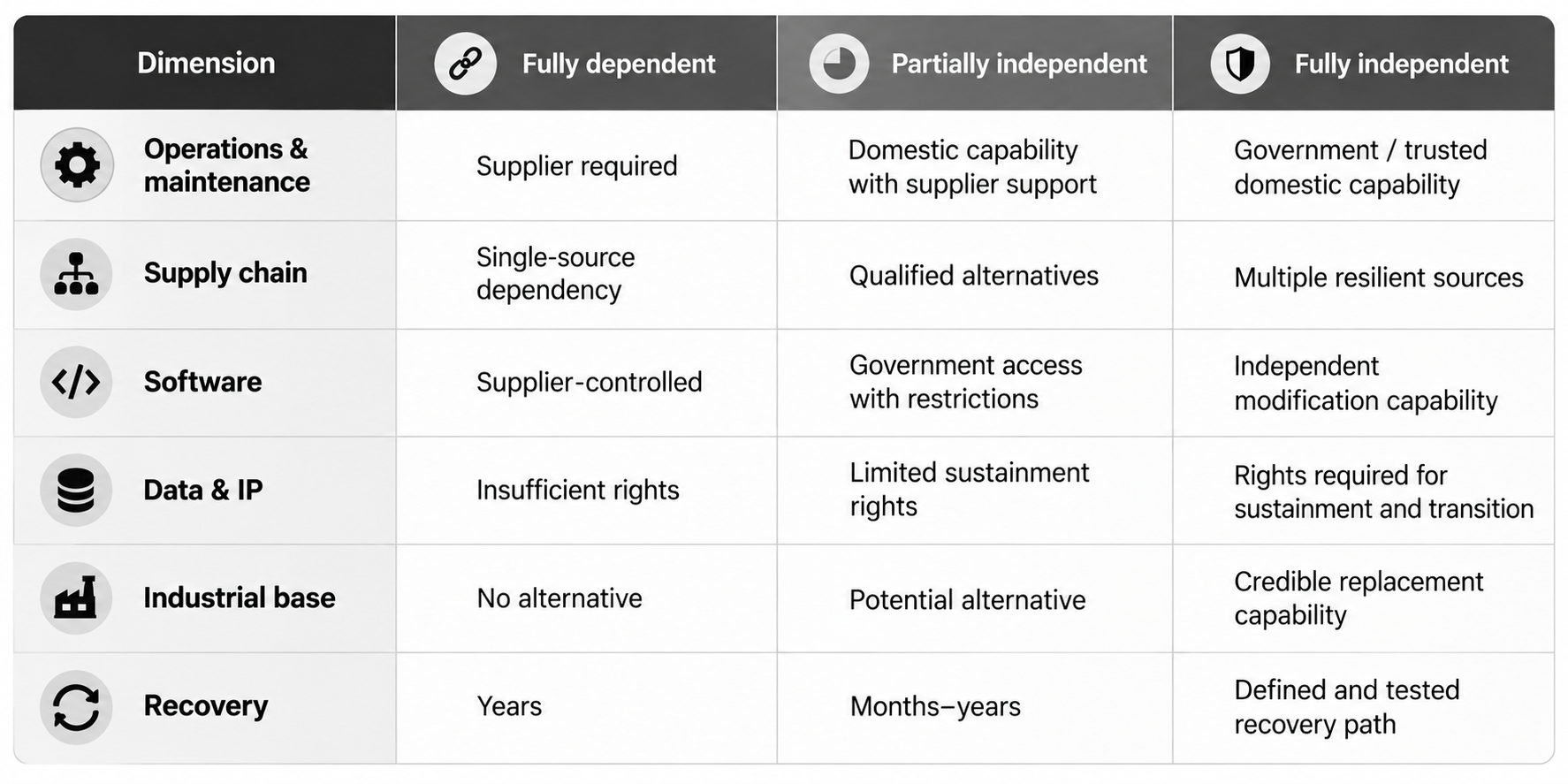
But there is an important principle - The weakest score matters more than the average.
A programme that scores highly across five dimensions but has a critical software dependency may not be sovereign in practice. Similarly, a domestically manufactured satellite may still have a strategic vulnerability if a single foreign supplier controls a mission-critical component with no qualified alternative.
Sovereignty is therefore constrained by the dependency that cannot be replaced.
The Test Should Be Applied Before Procurement
The Exit Strategy Test is not simply a resilience exercise to conduct after a system has been built. It should influence the architecture and procurement strategy from the beginning. Governments should work backwards from the failure scenario - If the supplier disappeared, what would we need? This question should then inform:
System architecture — avoid unnecessary proprietary lock-in and design for interfaces and interoperability.
Procurement strategy — preserve credible alternative sources where strategically important.
Contracts — establish appropriate sustainment, transition and data-delivery requirements.
Software arrangements — ensure the government has the rights and access needed for long-term support.
Supply chain — identify and mitigate single points of failure.
Industrial policy — develop a second source or domestic capability where the dependency is strategically critical.
Testing — periodically test whether another organisation could actually assume responsibility.
The objective is not to eliminate every external dependency as that would often be economically irrational. Instead, the objective should be to know which dependencies are acceptable, which are strategic, and how quickly each can be replaced if circumstances change.
From Sovereignty To Survivability
This framework changes how sovereign space should be assessed. Traditional assessments tend to ask - Who owns the satellite?
However, a more useful assessment asks - Who controls the capability?
The Exit Strategy Test goes one step further - Can that control survive the loss of the company that built or sustains it?
This distinction will become increasingly important as governments rely more heavily on commercial companies to develop and operate strategic space infrastructure. Commercial participation does not weaken sovereignty. In most cases, it is the fastest and most economically efficient route to building sovereign capability. But commercial dependence needs to be designed around an exit scenario pr failure scenario.
The strongest sovereign capability is therefore not necessarily the one with the highest level of domestic ownership. It is the one where the government has a credible answer to the most uncomfortable question - If the supplier disappeared tomorrow, could we keep the capability running?
If the answer is yes, sovereignty has been designed to survive. If the answer is no, sovereignty may exist at procurement — but not yet at sustainment.
————————————————————————————————————————————————————————————
Strategy&Blue works with space and deep-tech organisations, investors and public sector bodies to identify where structural advantage is forming in emerging technology markets, and to build strategies around it before it becomes consensus. Get in touch to discuss how we can help with your space economy roadmap - let's talk