
Orbital pharma will not be decided by launch cost. It will be decided by value per gram, by throughput per mission, and by who owns the molecule and the process.
From orbital experiments to industrial economics
The pharmaceutical industry has begun exploring a proposition that, until recently, remained largely within the domain of space research: that certain pharmaceutical compounds and biological materials may be processed more effectively in microgravity than under terrestrial conditions.
The proposition is attracting a new generation of companies -
Varda Space Industries is developing autonomous orbital manufacturing and recovery systems
Redwire's SpaceMD is expanding its pharmaceutical crystallisation platform
BioOrbit is developing specialised protein-processing systems
Serendipity Space is building an autonomous pharmaceutical manufacturing satellite.
Meanwhile, pharmaceutical companies are investigating whether microgravity can improve formulation, crystallisation and product characteristics.
The commercial case deserves more scrutiny than the industry narrative gives it. Producing a material in orbit does not show that it can be manufactured economically, repeatedly or at relevant volumes. The central question is whether microgravity creates enough incremental value to justify the cost of orbital production, recovery and regulatory validation.
Strategy&Blue's analysis points to a clear answer. Orbital pharma will not be decided by launch cost. It will be decided by value per gram, by throughput per mission, and by who owns the molecule and the process.
Our numbers frame the opportunity:
$60-120 per gram. The indicative cost of moving material to and from orbit on the ISS route, before any processing. That alone rivals the $80-150 per gram a terrestrial antibody plant spends to make the product.
$250 to $2,700 per gram. The range we estimate for processing on an autonomous free-flying capsule, from a mature-programme target to an early-mission case. The terrestrial benchmark is $80-150 and falling.
About 54 flights a year. What it would take to supply one blockbuster's annual volume from orbit (roughly 540 kg of Keytruda at list value) at 10 kg per flight. Planned cadence is about a tenth of that.
$150 million a year by 2035. Our base-case royalty pool from orbital-derived formulations. It is two and a half times the base-case spend on orbital services, which is why we expect the money to follow intellectual property, not hardware.
Our conclusion is that space is a credible tool for pharmaceutical formulation today, but a doubtful one for bulk manufacturing before the mid-2030s.
Commercial developments: evidence is moving beyond experimentation
The 2025-26 signals show capital, capacity and a major pharma proof point arriving together, and a key structural shift - the launch supplier becoming a competitor.
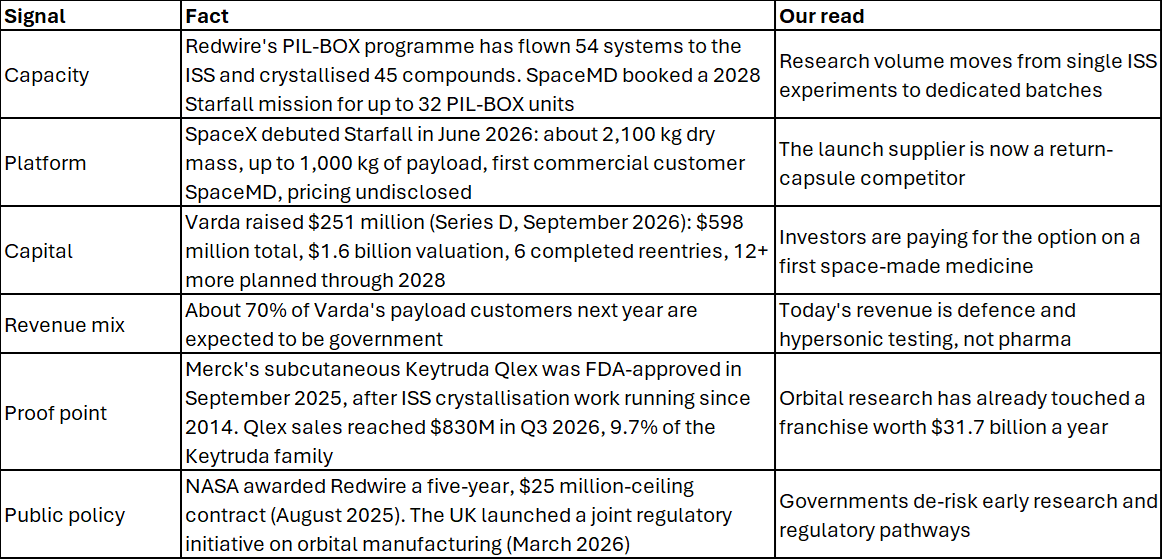
Three developments show where the industry is heading.
1) Merck: a terrestrial commercial outcome from orbital research:
One of the strongest examples of commercial relevance comes from Merck's work on pembrolizumab, marketed as Keytruda. Since 2014, Merck has run protein crystallisation experiments aboard the ISS. Microgravity research gave insight into crystal structure and particle-size distribution that helped researchers refine terrestrial production processes for a subcutaneous formulation.
The resulting formulation received FDA approval in September 2025. Subcutaneous administration takes about one minute, compared with an intravenous infusion that can take up to two hours. Qlex sales reached $830 million in the third quarter of 2026, an annualised $3.3 billion.
The distinction is critical: the medicine is manufactured on Earth. Microgravity research informed the development of the terrestrial formulation, which is a co-formulation with a second active ingredient. It did not establish a commercial orbital manufacturing process. What it did establish is the ratio that matters. A single reference orbital mission, which we model at about $8 million, costs less than 1% of one quarter of Qlex sales. Orbital research can create value without the final product ever being made in space..
2) Varda Space Industries: developing an orbital manufacturing and recovery model
Varda is pursuing a different proposition: autonomous pharmaceutical processing in orbit, followed by capsule recovery and terrestrial analysis or processing.
The company raised $250 million in September 2026 at a reported $1.6 billion valuation, bringing total funding to approximately $598 million. It has flown six uncrewed W-Series capsules since 2023, with five successful re-entries, although its mission portfolio also includes substantial government and hypersonic research activity.
In May 2026, Varda announced a collaboration with United Therapeutics to investigate microgravity-enabled formulations of small-molecule medicines for rare pulmonary diseases across multiple orbital missions.
The commercial significance is not simply the funding raised. It is the development of an integrated operating model combining spacecraft, autonomous processing, re-entry and recovery. The challenge is to demonstrate that this model can deliver pharmaceutical products with a measurable advantage over terrestrial alternatives.
3) Redwire / SpaceMD and BioOrbit: scaling specialised research platforms
Redwire's SpaceMD has reported that 54 Pharmaceutical In-Space Laboratory (PIL-BOX) systems had flown to the ISS since November 2023, with 45 unique compounds successfully crystallised. The company has announced a planned 2028 mission aboard SpaceX's Starfall spacecraft, with capacity for up to 32 PIL-BOX units.
BioOrbit, meanwhile, launched its Baby BOX-E platform to the ISS in May 2026. The approximately six-week mission produced protein crystals, and the company announced a £9.8 million seed funding round in October 2026.
These developments indicate growing commercial interest in dedicated pharmaceutical research and processing hardware. However, the number of experiments or compounds processed is not equivalent to the number of validated commercial products. The next milestone is demonstrating repeatability, product performance and customer willingness to pay.
The emerging competitive landscape
The sector is not a single market with interchangeable competitors. It is developing across pharmaceutical processing, research services, product development, orbital infrastructure and transportation, and the layers differ sharply in how much margin they are likely to hold.
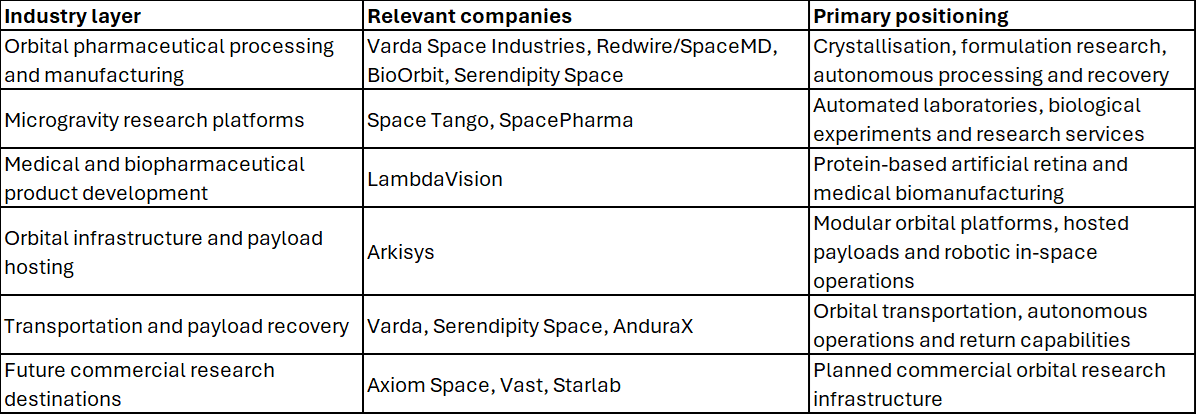
The distinction between these companies is strategically important.
Serendipity Space is particularly relevant to the Indian ecosystem. Its Alchemy system is designed as an autonomous pharmaceutical manufacturing module, integrated into a satellite with re-entry capability. In August 2026, the company reported a successful high-altitude balloon technology demonstration. This is a meaningful prototype milestone, but it is not an orbital pharmaceutical manufacturing demonstration. The company has not publicly announced an orbital mission or named pharmaceutical customer. Its position should therefore be assessed as early-stage technology development.
The company has raised about $0.6 million, roughly one-thousandth of Varda's funding, so it should be assessed as early-stage technology development. The strategic interest lies in what a small craft could prove. The lever is mass efficiency, the grams processed per kilogram launched. Varda's target is about 10 kg processed per 300 kg launched, or 3%. In Strategy&Blue's illustration, a 50 kg craft launched at SpaceX's $350,000 rideshare base price, with $150,000 of other mission costs, that processes 2 kg a flight would reach about $250 per gram. That matches Varda's target with a fifth of the cash at risk per flight. The illustration assumes a heat shield that works at orbital speed, which is the open question.
Arkisys occupies a different part of the value chain. Its Port architecture is designed for modular orbital infrastructure, payload hosting, robotic operations and in-space servicing. The company took over operation of NASA's Astrobee free-flyer as a commercial sustainer in January 2026, and it has offered payload flights to the Port at $150,000, a price its chief executive said would not make money. By comparison, an ISS experiment at NASA list prices costs about $295,000 on Strategy&Blue's illustrative 5 kg example. Arkisys could eventually host pharmaceutical experiments as the ISS retires, but it should not be classified as a pharmaceutical manufacturing company. Because material must come back to Earth, it is complementary to return-capsule providers, not a rival.
Space Tango and SpacePharma are relevant because they provide the research and laboratory infrastructure required to conduct experiments in orbit. LambdaVision is a different type of participant: it is developing a medical product using space-enabled manufacturing processes.
The emerging structure suggests that value may be captured at several levels: pharmaceutical intellectual property, specialised processing systems, recurring research services, orbital manufacturing operations and infrastructure access.
These are related but distinct business models.
Technology maturity: research capability is not manufacturing readiness
The industry has demonstrated that microgravity can influence crystallisation and biological processes. It has not yet demonstrated a commercially established, scalable pharmaceutical manufacturing industry in orbit.
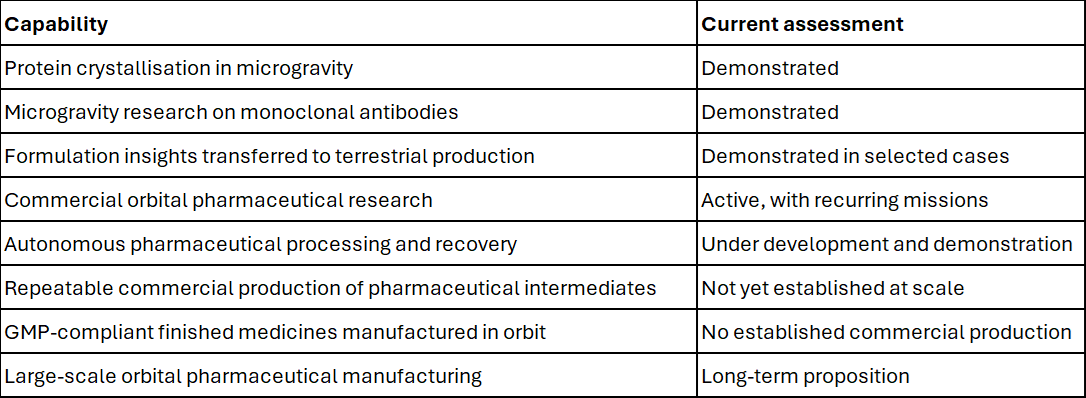
A key distinction is between improving a process through orbital research and manufacturing a regulated pharmaceutical product in orbit. The Merck example demonstrates the former. Varda, Redwire and BioOrbit are developing capabilities that could advance the latter, but further evidence is needed on production consistency, yield, quality control, batch reproducibility, recovery and regulatory acceptance. Strategy&Blue's own test for "repeatable" is at least three consecutive flights delivering material within the same quality specification.
The commercial maturity of the sector should therefore be judged by validated products and repeatable manufacturing outcomes, not by the number of experiments or missions announced.
The economics: what does it cost to manufacture in orbit?
This is where the commercial proposition becomes harder. The cost structure includes launch, payload integration, spacecraft and processing hardware, orbital operations, environmental control, recovery, ground processing, quality assurance and regulatory validation. For human-tended research, crew time is a significant expense on top.
The cost of transportation alone:
Unpowered cargo to orbit: $20,000/kg
Conditioned or late-load cargo to orbit: $45,000/kg
Powered cargo to orbit: $60,000/kg
Unpowered cargo return to Earth: $40,000/kg
Conditioned cargo return: $45,000/kg
Powered cargo return: $60,000/kg
ISS crew time: $130,000/hour
These are research-planning benchmarks, not universal commercial prices, however, they show the scale of the hurdle.
For a one-kilogram payload, the indicative transportation cost for unpowered delivery and return is already approximately $60,000/kg. Conditioned delivery and return would be approximately $90,000/kg, while powered delivery and return would be approximately $120,000/kg. That is $60-120 per gram before payload development, integration, processing, operations or ground validation, which already rivals the entire $80-150 per gram it costs to make an antibody on Earth. An illustrative 5 kg ISS experiment needing 1.5 hours of crew time costs about $295,000 in upmass and crew charges alone.
The economics of autonomous manufacturing and recovery
The free-flying capsule route avoids crew charges, but costs are still high at the start. Our reference-case model assumes a mission cost of about $8 million with 3-5 kg of usable output. That is a modelled case, not a disclosed Varda cost, and it sits between the roughly $12 million first-flight and $5-6 million fourth-flight costs the company has reported. Three cases show how fast the picture can change:

At the mature target, launch is about 84% of the bill: a 300 kg spacecraft at SpaceX's $7,000/kg rideshare rate costs about $2.1 million of the $2.5 million. Yet halving the launch price lowers cost per gram by only 42%, to $145, while quintupling processed mass lowers it by 80%, to $50. Throughput matters more than launch price. The Starfall figure is a scenario, because SpaceX has not published pricing and pharmaceutical hardware will not fill a capsule with product. The terrestrial benchmark is also moving: the best plants reach about $45 per gram and research platforms are demonstrating about $12, so even the Starfall-class case only matches the best plants.
What does this mean for the addressable product market?
The economics are unlikely to work equally well across pharmaceutical categories.
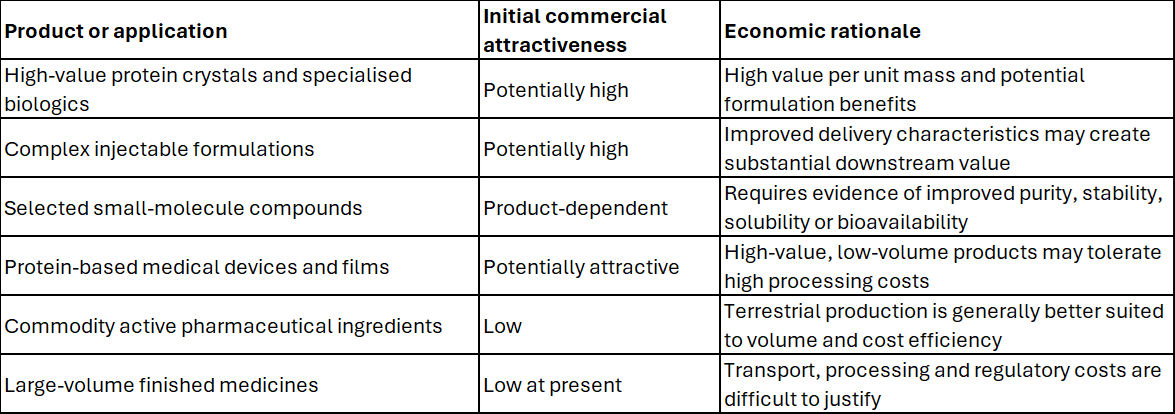
A useful screen is the price at which orbital cost falls below 5% of the product's price. That needs about $54,000 per gram at early-mission cost, $5,000 per gram at the mature target and $1,000 per gram at Starfall-class cost. Keytruda's list price is roughly $59,000 per gram (our calculation, assuming a 200 mg dose per $11,800 course), so a franchise of that kind clears even the early hurdle. A commodity antibody does not clear any of them.
The relevant economic comparison is not the cost of producing a kilogram of material in space against the cost of producing a kilogram on Earth in isolation. It is the incremental economic value created by the orbital process. If microgravity enables a formulation that cannot be produced reliably on Earth, improves drug delivery, reduces manufacturing complexity or creates a commercially differentiated product, the value could justify a substantial premium. If the same outcome can be achieved through terrestrial process engineering, the orbital manufacturing proposition becomes much weaker.
This is also why Merck's case is commercially significant despite the medicine being manufactured on Earth: the value of orbital research can be captured without bearing the full cost of orbital production.
The scale problem
A second challenge is throughput. Pharmaceutical manufacturing is generally designed around repeatable batches, stringent quality requirements and predictable supply. A capsule returning a few kilograms of material may be commercially useful for selected high-value applications, but it is not automatically a viable substitute for terrestrial manufacturing facilities.
The industry must demonstrate not only that a product can be made in orbit, but that the process can be repeated at the required quality, volume and cost.
There is currently insufficient publicly disclosed, comparable data to calculate an industry-wide cost per gram, cost per batch or commercial gross margin. This is itself a material investment risk. Companies that disclose mission costs, recovered yield, usable output and repeatability will be better positioned to establish commercial credibility.
Government participation: an enabler, not the ultimate customer
Government involvement is likely to remain important during the sector's early development.
NASA has supported commercial pharmaceutical research through ISS access and research programmes. The UK has also begun developing a regulatory pathway for space-manufactured medicines, involving the UK Space Agency, the Medicines and Healthcare products Regulatory Agency and other government bodies.
The UK's October 2026 announcement of BioOrbit's £9.8 million seed round and its earlier work on regulatory pathways illustrate how public-sector support can help de-risk emerging technologies.
There are three principal reasons for government involvement:
Research and technology development: Funding early experiments and reducing the cost of technology demonstration.
Infrastructure and access: Supporting commercial orbital platforms and research facilities.
Regulatory development: Establishing how products manufactured or processed in orbit will be assessed for quality, safety and compliance.
However, government funding should not be confused with sustainable commercial demand. Public agencies may support research, infrastructure and early missions, but pharmaceutical companies ultimately need to demonstrate that the resulting products create sufficient economic value.
The long-term market will depend on commercial procurement, not continuing public subsidies.
Where could the market move over the next decade?
The market is likely to develop in stages rather than move directly from research to large-scale orbital manufacturing.
2026–2030: commercial research and technology validation
The immediate opportunity is likely to remain in specialised experiments, formulation development, protein crystallisation and automated orbital processing. Redwire's planned 2028 Starfall mission, Varda's expanding capsule programme and BioOrbit's early ISS activity illustrate the direction.
The key commercial milestones will be recurring pharmaceutical customers, validated results and evidence that orbital processing creates an advantage that cannot be reproduced economically on Earth.
2030–2035: selective commercial production
If autonomous platforms, recovery systems and repeatable processing improve, selected high-value products could move towards more regular orbital production. The economics will favour products with high value per kilogram, limited production volumes and demonstrable performance advantages.
Commercial orbital destinations such as those being developed by Axiom Space, Vast and Starlab could provide additional research and processing capacity. However, their relevance will depend on the actual availability, cost and capabilities of their facilities.
Beyond 2035: a specialised manufacturing layer
Large-scale pharmaceutical production in orbit remains uncertain. Even if launch costs fall, the sector will still need to solve throughput, quality, recovery, supply-chain and regulatory challenges.
The more plausible long-term outcome is not the relocation of the pharmaceutical industry to space. It is the emergence of a specialised manufacturing and research layer serving selected products and processes where microgravity creates a defensible economic advantage.
Strategic implications for industry stakeholders
For pharmaceutical companies, the immediate priority is to identify specific molecules and manufacturing challenges where microgravity could create measurable improvements. Broad experimentation without a defined commercial problem is unlikely to justify sustained investment.
For space companies, the opportunity extends beyond providing launch capacity. The more defensible businesses may be those that own repeatable processing systems, autonomous operations, recovery capabilities and proprietary manufacturing processes. Take equity, milestones or royalties in customer molecules, not only fees, and manage dependence on a single launch supplier.
For biotechnology startups, intellectual property around crystallisation, formulation and biological processing may offer a stronger route to differentiation than simply developing another orbital laboratory.
For infrastructure providers such as Arkisys, the opportunity is to become part of the enabling layer for future in-space manufacturing. Their commercial relevance will depend on whether they can provide reliable, cost-effective and repeatable access to orbital services.
For investors, the critical indicators should be customer commitments, repeat missions, usable production yield, cost per successful batch, product validation and regulatory progress. Funding announcements and mission counts are useful indicators of sector activity, but they are not evidence of a sustainable pharmaceutical business model.
A specialised opportunity, not yet an industrial revolution
Microgravity-enabled pharmaceutical development is moving into a more commercially focused phase. Merck has demonstrated that orbital research can influence a successful terrestrial pharmaceutical formulation. Varda, Redwire/SpaceMD and BioOrbit are developing increasingly specialised processing capabilities, while Serendipity Space represents an emerging Indian attempt to build an autonomous pharmaceutical manufacturing platform.
However, the economics remain the decisive constraint. Transport alone costs $60-120 per gram on the ISS route, free-flying capsules cost $250-2,700 per gram against $80-150 on Earth, and no commercial-scale orbital pharmaceutical production exists. Broad manufacturing in space is difficult to justify today.
The opportunity is therefore likely to emerge selectively: high-value, low-volume products and specialised processes where the benefits of microgravity are demonstrable, difficult to reproduce on Earth and large enough to offset the cost of orbital operations.
The next phase of competition will be determined by who can convert microgravity into validated pharmaceutical outcomes, repeatable production processes and commercially defensible economics.
In our base case scenario, the leaders will be set in 2027-29 by who converts microgravity into validated pharmaceutical outcomes, repeatable production and defensible intellectual property before the ISS retires. By 2035 the money will sit where the molecule and the process are owned, not where the capsule is built.
Have specific questions on this? Ask BLUE
--------------------------------------------------------------------------------------------------
Frequently asked questions
What is microgravity pharmaceutical manufacturing?
Microgravity pharmaceutical manufacturing involves using the near-weightless environment of space to process pharmaceutical compounds, proteins and biological materials. It can influence crystallisation, particle formation and biological processes, potentially creating products or formulations with characteristics that are difficult to achieve on Earth.
Can medicines be manufactured more effectively in space than on Earth?
Potentially, for selected applications. Microgravity can improve certain crystallisation and formulation processes, particularly for complex proteins and biologics. However, it has not yet been established that orbital manufacturing can consistently outperform terrestrial production on cost, quality and scale.
Has any pharmaceutical company successfully commercialised a medicine developed using microgravity research?
Yes. Merck's Keytruda Qlex (subcutaneous pembrolizumab) is an important example. Research conducted aboard the International Space Station (ISS) informed the development of its terrestrial formulation. The medicine received FDA approval in September 2025. Importantly, the final product is manufactured on Earth, not in orbit.
Which companies are leading the orbital pharmaceutical manufacturing market?
Key participants include Varda Space Industries, Redwire's SpaceMD, BioOrbit and Serendipity Space. Other relevant companies include Space Tango and SpacePharma, which provide microgravity research platforms, and LambdaVision, which is developing protein-based medical products using space-enabled manufacturing processes.
What is Varda Space Industries developing?
Varda is developing autonomous orbital manufacturing systems that process materials in space before returning them to Earth in recovery capsules. Its model combines spacecraft, automated processing, orbital operations and terrestrial recovery. Its pharmaceutical activities include a collaboration with United Therapeutics to investigate microgravity-enabled formulations.
What is the role of Serendipity Space in India's orbital pharmaceutical manufacturing ecosystem?
Serendipity Space is developing Alchemy, an autonomous pharmaceutical manufacturing module integrated into a satellite with re-entry capability. Its August 2026 high-altitude balloon demonstration represents an early technology milestone, rather than a demonstration of orbital pharmaceutical manufacturing. Its progress will depend on demonstrating processing capabilities, orbital operations and successful material recovery.
How much does it cost to manufacture pharmaceutical materials in space?
Strategy&Blue estimates that autonomous orbital manufacturing could cost approximately $1,600–2,700 per gram in early missions, declining to around $250 per gram in a mature free-flying capsule model. An advanced, high-throughput Starfall-class scenario could potentially reach $50 per gram. These are modelled scenarios, not established commercial prices.
How does the cost of orbital pharmaceutical manufacturing compare with terrestrial manufacturing?
The typical terrestrial antibody manufacturing benchmark used in Strategy&Blue's analysis is approximately $80–150 per gram, with advanced plants potentially achieving lower costs. Current orbital manufacturing scenarios remain substantially more expensive. Orbital production therefore needs to deliver additional pharmaceutical value, such as improved formulation, delivery characteristics or product performance, to justify its premium.
Which pharmaceutical products are most suitable for manufacturing in microgravity?
The strongest initial candidates are likely to be high-value, low-volume products, including specialised biologics, protein crystals, complex injectable formulations and selected protein-based medical products. Commodity active pharmaceutical ingredients and large-volume finished medicines are considerably less attractive because terrestrial manufacturing benefits from established economies of scale.
What is the difference between orbital pharmaceutical research and orbital pharmaceutical manufacturing?
Orbital research uses microgravity to study pharmaceutical compounds and improve processes that may subsequently be implemented on Earth. Orbital manufacturing involves actually processing or producing pharmaceutical materials in space, recovering them and establishing that the process can meet commercial and regulatory requirements. The Merck example demonstrates the first, while companies such as Varda are developing capabilities for the second.
What is the potential market opportunity for orbital pharmaceutical manufacturing by 2035?
Strategy&Blue's base-case scenario estimates an annual royalty pool of approximately $150 million by 2035 from orbital-derived formulations. This reflects the potential value captured through pharmaceutical intellectual property and differentiated formulations rather than simply revenue from spacecraft, launch or orbital infrastructure services.
Will orbital pharmaceutical manufacturing replace conventional pharmaceutical factories?
Unlikely in the foreseeable future. Terrestrial facilities will remain more economical for most high-volume pharmaceutical production. Orbital manufacturing is more likely to develop as a specialised capability serving products where microgravity provides a measurable and commercially defensible advantage.
What should investors look for when evaluating orbital pharmaceutical manufacturing companies?
Investors should focus on commercial evidence rather than mission announcements or funding alone. Important indicators include repeat customer commitments, successful recovery of usable material, cost per gram, production yield, batch reproducibility, regulatory progress and ownership of proprietary processing technology or pharmaceutical intellectual property.
When could orbital pharmaceutical manufacturing become commercially viable at scale?
The period from 2026 to 2030 is likely to focus on research, technology validation and recurring commercial experiments. Between 2030 and 2035, selected high-value products could move towards more regular orbital production if processing, recovery and manufacturing economics improve. Large-scale pharmaceutical manufacturing in orbit remains a longer-term and uncertain proposition.
--------------------------------------------------------------------------------------------------
Strategy&Blue works with space and deep-tech organisations, investors and public-sector bodies to identify emerging opportunities, assess strategic risks and build commercially relevant strategies. Get in touch to discuss your space economy priorities.